History of The Louvre
The Louvre
-
With 9.6 million visitors in 2019, the Louvre Museum can absolutely boast that it is the most visited museum in the world.
-
Perhaps visitor numbers reflect that the Louvre’s collection includes the most famous painting in the world – the Mona Lisa. But visitors don’t just come to see Leonardo da Vinci’s mysterious lady and her smile; the Louvre holds perhaps the largest collection of ancient Egyptian, Greek, and Roman art and artifacts.
-
It also has the largest collection of French paintings as well as the Italian Renaissance masters like Leonardo, Perugino, Veronese, Titian, and Raphael. A large part of the collection is made up of preparatory drawings, engravings, and objets d’art.
-
All of this is arranged in three wings of the Louvre Palace, formerly the home of the French Monarchs. We recommend planning your visit beforehand and researching what you want to see. You should be prepared for a lot of walking! Not only is the Louvre the most visited, but it is one of the largest museums in the world at over 60,000 square meters of gallery space!
With 9.6 million visitors in 2019, the Louvre Museum can absolutely boast that it is the most visited museum in the world.
Perhaps visitor numbers reflect that the Louvre’s collection includes the most famous painting in the world – the Mona Lisa. But visitors don’t just come to see Leonardo da Vinci’s mysterious lady and her smile; the Louvre holds perhaps the largest collection of ancient Egyptian, Greek, and Roman art and artifacts.
It also has the largest collection of French paintings as well as the Italian Renaissance masters like Leonardo, Perugino, Veronese, Titian, and Raphael. A large part of the collection is made up of preparatory drawings, engravings, and objets d’art.
All of this is arranged in three wings of the Louvre Palace, formerly the home of the French Monarchs. We recommend planning your visit beforehand and researching what you want to see. You should be prepared for a lot of walking! Not only is the Louvre the most visited, but it is one of the largest museums in the world at over 60,000 square meters of gallery space!
A Royal Palace
Like many grand museums around the world, the Louvre started life as something else. It was built as a fortress at the end of the 12th century, to protect the city in the event of attack, parts of the Medieval building can still be seen in the basement today. Converted to a residence in the 14th century by Charles V, the fortress gradually became a palace.
By the sixteenth century it was the official residence of the French kings; entirely remodelled in 1546 by Francis I who started the Renaissance building we know today. After only a century, the building works stopped and the Royal household was moved to Versailles by Louis XIV in 1678.
From that moment on, the Louvre Palace housed only the art of the Royal families. In 1692, part of the palace became home to two of France’s great academies of learning dedicated to inscriptions, sculpture, and painting: Académie des Inscriptions et Belles-Lettres and the Académie Royale de Peinture et de Sculpture.
But the palace had been left unfinished, the Cour Carrée buildings were left roofless for almost a century until in 1756, Louis XV started work on the castle again.
National Museum
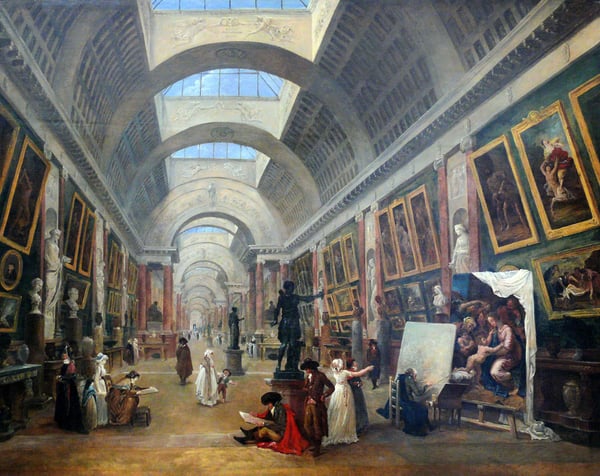
The Louvre became a National Museum during the French Revolution, opening its doors to the public in 1793. Visitors could see 537 paintings from the royal collection for free on weekends, displayed in the Salon Carré and Grande Galerie. The highlight of the collection was the Mona Lisa, acquired by Francis I in 1518.
Napoleon expanded the Louvre's collection by looting treasures from the places his armies conquered, including Vatican City and other parts of Italy. After his reign, some stolen pieces were returned, but many remained in the museum. Over 695 Greek and Roman statues and Italian Renaissance paintings came from the Galleria Borghese in Rome, thanks to Napoleon’s sister, Pauline, who married Roman noble Camillo Borghese.
In the 19th century, the museum’s collection grew further through donations and acquisitions, a process that continues today. Now, the Louvre holds over 380,000 objects across eight departments, including Egyptian, Near Eastern, Greek, and Roman antiquities; Islamic art; sculpture; decorative arts; paintings; and prints and drawings.
.jpg)
Pyramid Paris
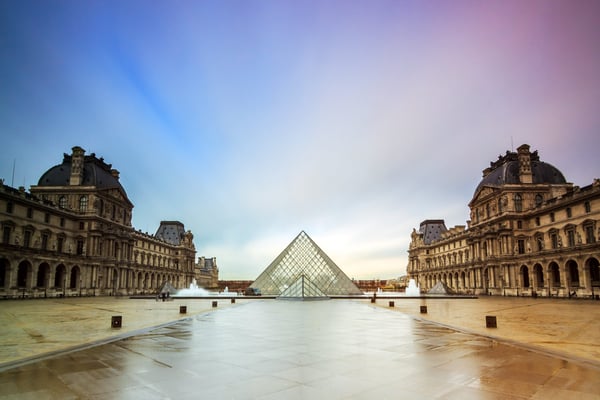
The most recent architectural addition to the Louvre is the iconic glass pyramid that sits in the center of the palace courtyard. The daring, modern, centerpiece was completed in 1988, designed by the Chinese architect Leoh Ming Pei. The 21-meter high (71ft) pyramid is made entirely of glass panels and metal poles and spans 1,000 square meters (11,000 sq. ft).
The pyramid provided a much-needed new entrance to the museum. With the increasing number of visitors, the museum layout simply couldn’t cope. From the pyramid, visitors descend to a main hall from where they can access the collections in the three wings above, as well as numerous services including a lift for disabled access.
From below, the open, glass-covered space is reminiscent of a Roman villa. Escalators and a hanging spiral staircase descend and the space takes on the thoroughly modern aspect of passenger terminals.
Architecturally it was hugely controversial. Criticism ranged from being too modern, an inappropriate symbol of death, or too foreign as the architect had insufficient knowledge of French culture. It has even been linked with the devil! (See Interesting Facts).
Regardless, the pyramid is an icon of Paris today alongside another metal giant – the Eiffel Tower.