Interesting Facts
Ghosts at the Louvre
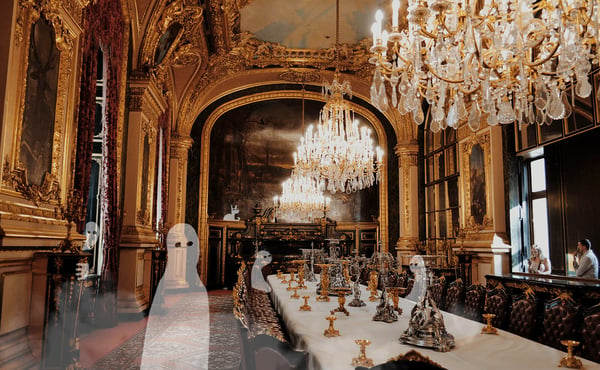
Like most old buildings, the Louvre has a few ghost stories. As the former residence to the monarchs, the Palace no doubt saw its fair share of treachery and murder. But the Louvre has not one, but two famous ghosts! One, an Egyptian mummy called Belphegor even had a film made about him in the 1960s. The second, Jean l’Ecorcheur, known as ‘Jack the Skinner’ was a brutal henchman to the queen Catherine de Medici.
According to legend, Catherine had Jean put to death because he knew too many secrets about her. Despite being made famous on the big screen, sightings of Belphegor are relatively rare, however tourists and Louvre staff claim to have seen ‘Jack the Skinner’ near the Tuileries gardens – even Napoleon claimed to have seen the ‘Red Man of the Tuileries’.
Mona Lisa went missing for two years
-
Leonardo da Vinci’s Mona Lisa is undoubtedly the most famous painting in the world, but the reason why may very well be because she was stolen! La Gioconda as the painting is sometimes known has hung in the Louvre since 1804. Before that, it was in the Royal collection since it was sold to King Francis I after Leonardo’s death.
-
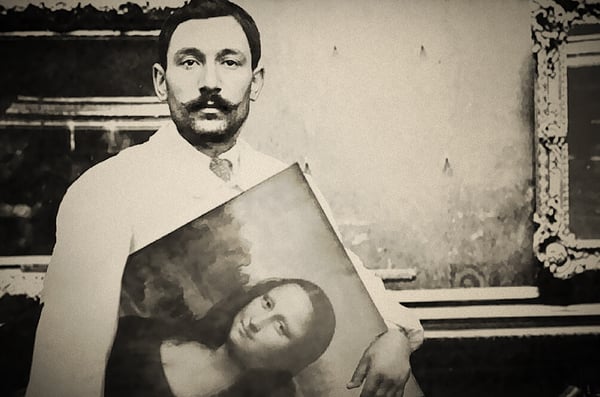
On a summer day in August in 1911 an Italian man who worked at the Louvre took the Mona Lisa off the wall and walked out with it under his arm covered in an overall. Vincenzo Peruggia, a member of staff at the Louvre claimed the theft was an act of patriotism. Peruggia believed that the Mona Lisa was one of the many paintings looted from Italy by Napoleon. He was merely returning the painting to its rightful place.
-
Amid the current clamour for returning looted artefacts, we might agree with Peruggia’s story, but letters were later found telling his father he was going to be rich. After stashing the painting in a cupboard in Paris for two years, he took it to Italy where he kept it in his apartment in Florence. Peruggia was finally caught when he contacted the Uffizi in Florence to authenticate and value the painting, they immediately contacted the police.
-
After a short spell in Florence, where Mona Lisa was displayed alongside several of Leonardo’s other masterpieces, she returned to Paris far more famous than when she had left!
Leonardo da Vinci’s Mona Lisa is undoubtedly the most famous painting in the world, but the reason why may very well be because she was stolen! La Gioconda as the painting is sometimes known has hung in the Louvre since 1804. Before that, it was in the Royal collection since it was sold to King Francis I after Leonardo’s death.
On a summer day in August in 1911 an Italian man who worked at the Louvre took the Mona Lisa off the wall and walked out with it under his arm covered in an overall. Vincenzo Peruggia, a member of staff at the Louvre claimed the theft was an act of patriotism. Peruggia believed that the Mona Lisa was one of the many paintings looted from Italy by Napoleon. He was merely returning the painting to its rightful place.
Amid the current clamour for returning looted artefacts, we might agree with Peruggia’s story, but letters were later found telling his father he was going to be rich. After stashing the painting in a cupboard in Paris for two years, he took it to Italy where he kept it in his apartment in Florence. Peruggia was finally caught when he contacted the Uffizi in Florence to authenticate and value the painting, they immediately contacted the police.
After a short spell in Florence, where Mona Lisa was displayed alongside several of Leonardo’s other masterpieces, she returned to Paris far more famous than when she had left!
Louvre Masterpieces saved from the Nazis
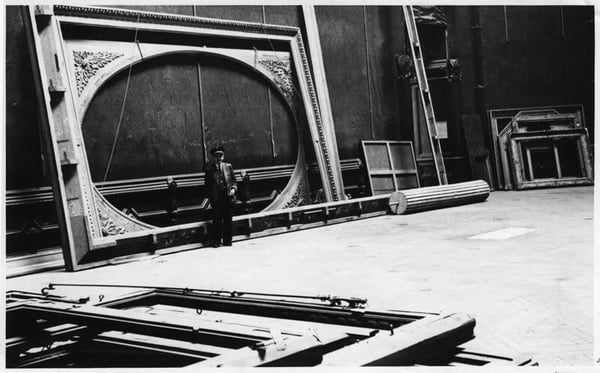
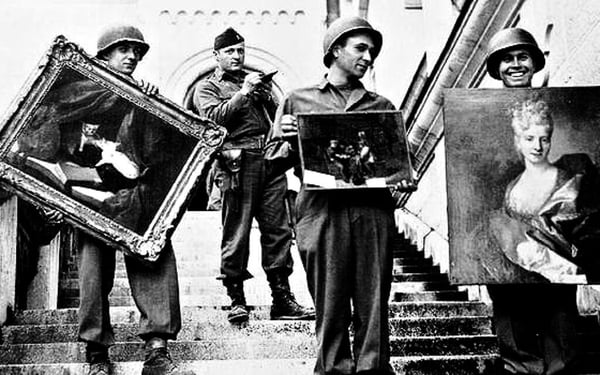
In 1940, France was defeated by Nazi Germany and Hitler rode into town like a triumphant Emperor. Like other despots before him, he pillaged artwork and cultural heritage from the cities he invaded. What a disappointment it must have been when his soldiers entered the Louvre Museum and found it almost empty! Thanks to the director of the French National Museums, Jacques Jaujard; over 4,000 pieces of precious
-
masterpieces were removed in secret to prevent Nazi troops from getting their hands on the priceless collection.
-
The evacuation of France’s cultural heritage was planned as war loomed in 1938. Rural sites were chosen; chateaus and villas that were well hidden and far from strategic sites, in the hope they would evade bombing.
-
The Mona Lisa was the first to leave the museum on 28th August 1939 and would be moved another five times before the end of the war. Less than a week later, war was declared and the race was on to remove the most precious pieces. Hundreds of crates filled with statues and decorative objects along with over 3,000 paintings were sent out into the French countryside.
Stolen Artwork in the Louvre
-
During the Second World War, Nazi soldiers looted countless works of art from across Europe. They didn’t just take from museums and galleries but also from private homes, especially those belonging to Jewish families. What many don’t know is that some of these stolen treasures ended up being stored at the Louvre.
-
After the war, a French commission was set up to track down and return these artworks. Over 45,000 pieces were given back to their rightful owners, but many remain unclaimed. In 2018, the Louvre opened two new rooms on the second floor of the Richelieu wing to display some of these works, hoping to reunite them with their owners. The collection includes over 1,737 treasures still waiting for a home.
-
The Louvre itself is no stranger to controversy around its collection. During the 16th century, the museum acquired masterpieces like the Venus de Milo. Under Napoleon III, the Louvre expanded further, bringing in Italian Renaissance works and other art from across Europe. This mix of history and culture adds layers to its story.
-
While these stolen works remind us of the horrors of war, the Louvre remains a symbol of art’s resilience, preserving treasures for future generations to admire and, when possible, return to their rightful owners.
During the Second World War, Nazi soldiers looted countless works of art from across Europe. They didn’t just take from museums and galleries but also from private homes, especially those belonging to Jewish families. What many don’t know is that some of these stolen treasures ended up being stored at the Louvre.
After the war, a French commission was set up to track down and return these artworks. Over 45,000 pieces were given back to their rightful owners, but many remain unclaimed. In 2018, the Louvre opened two new rooms on the second floor of the Richelieu wing to display some of these works, hoping to reunite them with their owners. The collection includes over 1,737 treasures still waiting for a home.
The Louvre itself is no stranger to controversy around its collection. During the 16th century, the museum acquired masterpieces like the Venus de Milo. Under Napoleon III, the Louvre expanded further, bringing in Italian Renaissance works and other art from across Europe. This mix of history and culture adds layers to its story.
While these stolen works remind us of the horrors of war, the Louvre remains a symbol of art’s resilience, preserving treasures for future generations to admire and, when possible, return to their rightful owners.
Problems with the Pyramid
-
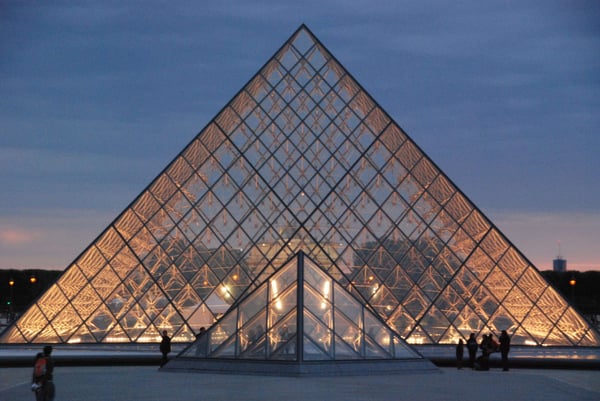
The iconic glass pyramid in the Louvre’s courtyard is now a global symbol of Paris. Its sleek design, crafted by Chinese-American architect I.M. Pei, has been copied worldwide. But when it was unveiled, it sparked controversy.
-
Many felt its modern style didn’t match the neoclassical Louvre palace. Some critics even claimed it was a “symbol of death” linked to ancient Egypt.
-
Others grumbled about hiring a foreign architect, saying Pei didn’t understand French culture. The pyramid was nicknamed “Pharaoh Mitterrand’s Pyramid,” poking fun at the French president who approved the design. Another bizarre rumor was that the pyramid was the “sign of the beast” because it supposedly contained 666 panes of glass.
-
This conspiracy gained traction in the 1980s and later appeared in The Da Vinci Code, connecting the pyramid to the devil. In reality, the pyramid has 673 glass panes!
-
The pyramid was part of the Grand Louvre Project, a major renovation launched in the 1980s to modernize the museum. The project’s goal was to make the Louvre a global hub for art and culture in the 21st century. Today, it showcases works of art from ancient civilizations to masterpieces from the 19th century and beyond.
-
During World War II, the Louvre faced threats of looting, and much of its art was hidden. The museum survived the French Revolution and evolved through history to become what it is today. The glass pyramid, once divisive, now represents this journey—a blend of tradition and innovation.
The iconic glass pyramid in the Louvre’s courtyard is now a global symbol of Paris. Its sleek design, crafted by Chinese-American architect I.M. Pei, has been copied worldwide. But when it was unveiled, it sparked controversy.
Many felt its modern style didn’t match the neoclassical Louvre palace. Some critics even claimed it was a “symbol of death” linked to ancient Egypt.
Others grumbled about hiring a foreign architect, saying Pei didn’t understand French culture. The pyramid was nicknamed “Pharaoh Mitterrand’s Pyramid,” poking fun at the French president who approved the design. Another bizarre rumor was that the pyramid was the “sign of the beast” because it supposedly contained 666 panes of glass.
This conspiracy gained traction in the 1980s and later appeared in The Da Vinci Code, connecting the pyramid to the devil. In reality, the pyramid has 673 glass panes!
The pyramid was part of the Grand Louvre Project, a major renovation launched in the 1980s to modernize the museum. The project’s goal was to make the Louvre a global hub for art and culture in the 21st century. Today, it showcases works of art from ancient civilizations to masterpieces from the 19th century and beyond.
During World War II, the Louvre faced threats of looting, and much of its art was hidden. The museum survived the French Revolution and evolved through history to become what it is today. The glass pyramid, once divisive, now represents this journey—a blend of tradition and innovation.
Rap Music meets the Louvre
-
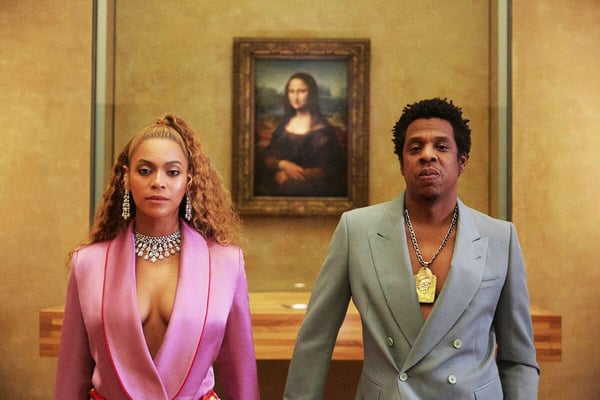
The music world was stunned when Beyonce and Jay-Z released their surprise collaboration ‘Everything is Love’ in 2018. A greater surprise for the art world was the video ‘Apes***’ which featured the famous couple standing poised in front of the Mona Lisa, reclining in a Royal pose and with dancers alongside some of the most famous pieces in the museum.
-
Filming in the Louvre reportedly costs a whopping $17,500, but ultimately the museum agreed to the shoot because ‘it was clear the couple and their project showed a real attachment to the museum and its beloved artworks’. After the video’s release, the Louvre recorded the highest attendance to the museum ever seen!
The music world was stunned when Beyonce and Jay-Z released their surprise collaboration ‘Everything is Love’ in 2018. A greater surprise for the art world was the video ‘Apes***’ which featured the famous couple standing poised in front of the Mona Lisa, reclining in a Royal pose and with dancers alongside some of the most famous pieces in the museum.
Filming in the Louvre reportedly costs a whopping $17,500, but ultimately the museum agreed to the shoot because ‘it was clear the couple and their project showed a real attachment to the museum and its beloved artworks’. After the video’s release, the Louvre recorded the highest attendance to the museum ever seen!